
Summit County Parole Hearing Path
A Summit County defendant reaches the Colorado parole hearing path only after a state-prison sentence or parole case. The county jail release may have been a transfer to CDOC, not a release home. Once CDOC has custody, the public state-prison release path includes offender search, parole eligibility fields, estimated mandatory release fields, and the State Board of Parole calendar.
The parole board calendar inside CDOC offender search displays monthly calendars. The research notes that the page warns hearings and scheduling are subject to change and that DOC modifications are available the following business day. It also states parole hearings are open for public attendance with advance arrangements. For application or rescission hearings, contact the offender's case manager; for revocation hearings, contact the jail where the offender is located.
Check Colorado Parole Calendars
- Start with Colorado DOC Offender Search to confirm the person is a DOC inmate or parolee.
- Open the parole-board calendar at CDOC parole board calendars.
- Use the monthly calendar to locate the hearing date and schedule entry when available.
- Check the CDOC profile after the hearing for status or date changes.
- Use the Summit County court record for the original sentence and mittimus, and use CDOC or the case manager for official release processing details.
Do not apply parole-board timing to a person released from Summit County jail on bond, time served, dismissal, or probation. Those are court and sheriff paths, not parole hearing paths.
Colorado Parole Outcomes
The parole calendar is a schedule. Release proof comes later through CDOC status, records follow-up, or the supervising authority. A grant means parole was approved subject to conditions and processing. Denial means no parole release from that hearing. Deferred or continued means the decision was postponed. Rescinded means a prior grant was taken back before release. Revoked means parole was ended after violation proceedings and custody may resume. Re-paroled means release again after revocation or reincarceration. Discharge means the sentence or parole obligation ended.
| Outcome | Release meaning |
|---|---|
| Granted | Approved, but release can depend on plan approval, detainers, and processing |
| Denied | No release from that hearing |
| Deferred | No final action yet |
| Rescinded | A prior grant was withdrawn before release |
| Revoked | Parole ended due to violation proceedings |
Parole Is Not Summit County Probation
Parole and probation are often confused after release. Probation is a court sentence supervised by the Colorado Judicial Branch in the 5th Judicial District. Parole follows a state-prison sentence and is supervised through CDOC and the State Board of Parole. A Summit County person can be released from jail to probation without ever entering CDOC parole. A state-prison inmate can be paroled without having a new Summit County jail release.
Use Summit County Probation for court-supervision records. Use this parole page only for CDOC parole hearings, parole board context, and state-prison release decisions.
Colorado Parole Calendar Source
The official CDOC parole board calendar is the source for monthly hearing schedules and schedule-change caveats.
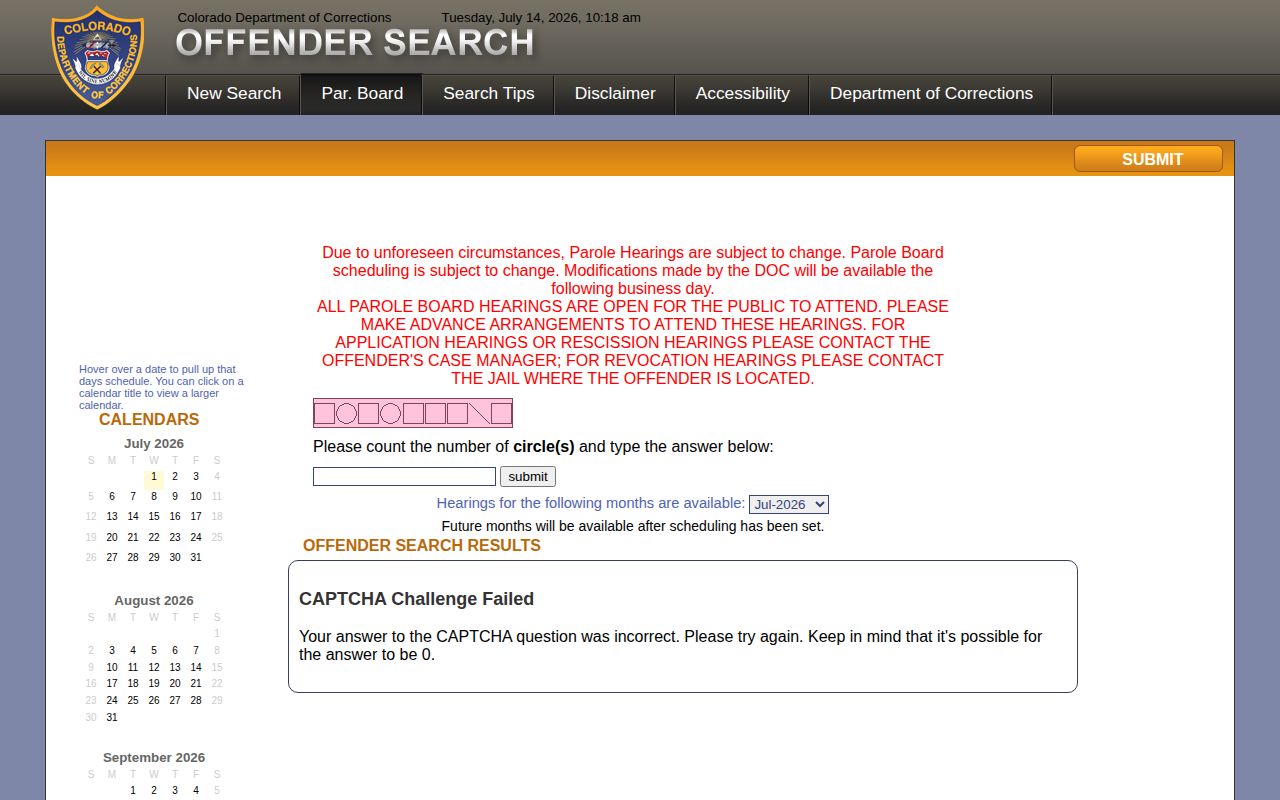
Use it as a schedule source, then confirm release status through CDOC profile, records follow-up, or the case manager.
Summit County Hearing Is Not Release
A parole hearing date is a process date. It does not prove that a Summit County state-prison inmate has been released, and it does not prove that the person will be released on the hearing date. A grant may require plan approval, bed space, detainer review, transportation, paperwork, or later processing. A hearing may be continued or rescheduled. A rescission hearing can take back a prior grant before release. A revocation hearing can return a parolee to custody.
This is why a parole calendar should be paired with the CDOC offender profile. The profile may show custody status, parole status, a next hearing date, or a release/discharge update after the board process moves. For a Summit County origin case, the local court record still explains the sentence that sent the person to DOC.
Colorado Parole Record Follow-Up
The research did not confirm a separate current public decisions database that should be promised for every named person. The confirmed path is calendar plus CDOC profile and records follow-up. Older parole-board hearing and decision publications may exist in state publications, but for a current Summit County person the practical route is the profile, the board/case-manager process, or public-record request where available.
For application or rescission hearings, CDOC directs contact to the offender's case manager. For revocation hearings, the calendar page directs contact to the jail where the offender is located. If a Summit County parolee is held locally on a revocation matter, the sheriff or court may also have custody or hearing records.
Colorado Parole Eligibility Limits
Parole eligibility is controlled by Colorado Title 17, sentence type, offense date, earned time, and board action. It is not the same as mandatory release, and it is not the same as discharge. The research flags earned-time rules under CRS 17-22.5-405 and parole-eligibility provisions in Title 17. Because Colorado rules differ by offense and have changed over time, the public page should rely on the CDOC displayed calculation and official confirmation rather than a one-size formula.
For county jail sentences, do not use CDOC parole eligibility at all. Summit County local jail deductions, trustee credits, mittimus terms, and sheriff/court records control those local dates. The parole calendar belongs to state-prison release decisions.
Summit County Parole Proof Chain
A complete Summit County parole release check usually needs four sources. The local court record shows the sentence to DOC. The sheriff or jail record can show the transfer out of Summit County custody. The CDOC profile shows state custody, parole eligibility, release, parole, or discharge status. The parole calendar explains public hearing dates and schedule changes. None of those sources alone answers every question.
If the board grants parole, check the CDOC profile later and confirm through CDOC or the case manager when exact timing matters. If the board denies or defers parole, the person may remain in state custody even though a public hearing occurred. If the person is held locally on a revocation matter, the jail and court records may again become relevant.
Colorado Parole Calendar Cadence
The research captured the parole-board page as showing monthly calendars and instructions to hover over dates or click calendar titles for larger views. It also captured the warning that hearings are subject to change and DOC modifications become available the following business day. That cadence means users should recheck the calendar close to the hearing and avoid treating an older screenshot or cached schedule as final.
For Summit County records, the calendar is a timing clue. The release decision and actual custody status still require CDOC status follow-up. A state-prison release can also be delayed by detainers, release-plan review, rescission, or logistics after the hearing.
Summit County Parole Source Order
Start with the Summit County court record to confirm a DOC sentence, then use CDOC offender search to confirm state custody or parole status, then use the parole calendar for hearing timing. If the person was never sentenced to DOC, this page should not be the main release source. Local jail release, probation, bond, and time-served events belong to sheriff and court records.
After a hearing, recheck CDOC rather than relying only on the calendar. The calendar shows that a hearing was scheduled. It does not certify that release occurred, that a plan was approved, or that a detainer did not delay release.