
Parole vs Probation in Summit County
Parole and probation answer different release questions in Summit County. Probation is imposed by the court, often after a person is released from jail or instead of a longer custody term. It is supervised through the Colorado Judicial Branch and the 5th Judicial District probation system. Parole follows a Colorado state-prison sentence. It is a CDOC and Colorado State Board of Parole path after a prison release decision, mandatory release event, revocation, or reparole.
| Status | Who Supervises | Best Verification Path |
|---|---|---|
| Probation | Colorado Judicial Branch, 5th Judicial District Probation | Summit County court docket, probation order, and Summit County Probation office. |
| Parole | CDOC parole services and the Colorado State Board of Parole | CDOC offender search, parole board calendar, case manager or parole contact, and records follow-up. |
| Bond or pretrial release | Court and sheriff custody process | Bond order, next court date, jail release record, and court docket. |
| Discharge | End of sentence or supervision authority | CDOC profile or court record, depending on whether the sentence was prison or local court supervision. |
The distinction prevents a common error. A person can leave the Summit County Detention Facility and still have a pending court case, a probation sentence, a CDOC parole term, or no active supervision. A missing jail roster entry does not prove parole, probation, discharge, or absconder status.
- Parole
- State supervision after release from a Colorado prison sentence.
- Probation
- Court-ordered community supervision, often tied to a county or district court case.
- Absconder
- A supervised person alleged to have stopped reporting or become unavailable to supervision authorities.
- Discharge
- The end of a sentence or supervision authority, not just release from a jail cell.
How to Verify Summit County Post-Release Supervision
Verification starts with the sentence source. A Summit County jail release after bond is not probation. A transfer to CDOC is not local jail release into the community. A probation sentence may be visible in the court docket or register of action, while the details of supervision may be limited. A parole hearing or parole grant belongs to the state-prison system and should be checked through CDOC and the parole board schedule.
- Use the Summit County court record to identify the disposition, bond order, probation sentence, mittimus, warrant event, or revocation action.
- If the court record shows probation, use the Summit County Probation path for local judicial supervision context.
- If the person was sentenced to state prison or transferred to CDOC, search the CDOC offender search by DOC number or name.
- For parole timing, check the Colorado State Board of Parole calendar and then confirm with CDOC, the case manager, or records channels.
- Use Summit County VINE and Colorado VINELink for custody-change notifications when the person remains in a participating custody record.
For release documentation rather than supervision status, use the county search and records coverage on Summit County released inmates. A release record shows the custody event. A supervision record shows what authority, if any, continues after that event.
Summit County Supervising Office
The clearest Summit-specific supervision office in the research is judicial probation. The Colorado Judicial Branch Summit County Probation page says 5th Judicial District probation offices are open to the public Monday through Friday and encourages clients to call to schedule appointments whenever possible. A named Summit County CDOC parole office was not confirmed in the official sources reviewed, so CDOC parole assignments should be verified through CDOC, C-WISE, the case manager, or the parole officer rather than guessed from geography.
Summit County Probation
Colorado Judicial Branch, 5th Judicial District Probation
Summit County Justice Center area
501 N. Park Avenue
Breckenridge, CO 80424
Phone listed in research: 970-471-0035
Public office schedule: Monday-Friday, appointment calls encouraged
For state parole, the Colorado State Board of Parole calendar and CDOC offender search are the public starting points. The parole calendar itself says hearing schedules can change and that DOC modifications are available the following business day. A calendar listing should be treated as a hearing schedule, not proof that the person has been released.
The CDOC parole-board calendar was captured from the official public offender search site.
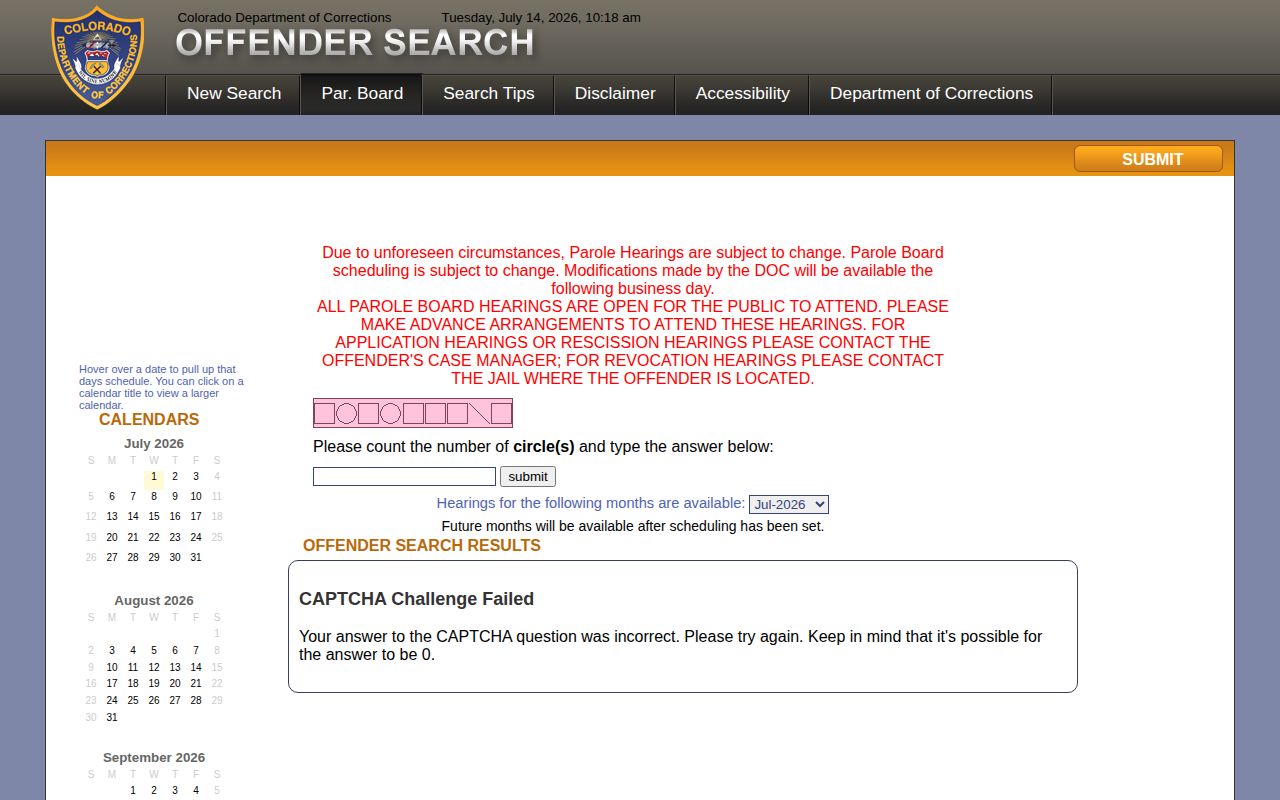
The calendar matters for Summit County state-prison cases because parole eligibility and hearing action can explain why a person is still in prison, released to parole, revoked, or awaiting a later decision.
Summit County Violations and Warrants
Supervision conditions are not the same as custody status. A probation order can require reporting, treatment, travel limits, court payments, or other court-set terms. A parole plan can include CDOC reporting, approved residence, treatment, and other state terms. The public record may show the existence of supervision, a hearing, or a warrant event, but it may not show every condition. Exact requirements must come from the court, probation officer, parole officer, or CDOC.
No Summit County sheriff absconder list specific to released inmates was found. Colorado parole warrant or absconder status may appear through CDOC, law-enforcement warrant records, VINE, court dockets, or local sheriff records. Do not infer absconding from a missed projected release date, a lack of current online roster entry, or a stale third-party result. A person may be transferred, discharged, on probation, out on bond, or outside the scope of a public online tool.
| Event | What It Usually Means | Where to Check |
|---|---|---|
| Probation revocation filing | The court is being asked to respond to an alleged probation violation. | Summit County court docket and probation office. |
| Parole revocation | CDOC parole may be terminated and custody may resume. | CDOC offender search, parole records, VINE, and jail if held locally. |
| Warrant recall | A warrant may have been canceled or resolved by court action. | Court docket or clerk record. |
| Absconder allegation | The supervising agency may allege the person stopped reporting or cannot be located. | CDOC/parole, court warrant records, and law-enforcement confirmation. |
How Summit County Supervision Ends
Supervision ends by discharge, court order, completion of probation, expiration of sentence authority, or another official action. For probation, the court case and probation office are the logical sources. For parole, CDOC status, parole records, and discharge information are the state sources. The word "released" should not be used as a shortcut for discharge because a person can be physically released from jail or prison and still remain under supervision.
Colorado public-record rules affect how much of that ending is visible. Sheriff records and booking photos fall under criminal-justice records procedures. Court records are governed by judicial access rules and may be sealed or protected. CDOC public search data can contain errors and should be confirmed when the exact date, authority, or official status matters. Sealed records are hidden from public view but may still exist for authorized agencies.
Note: A court disposition can explain supervision, but it is not always the same as the jail's physical release timestamp.
Summit County Reentry After Release
Summit's S.T.A.R.R. program gives post-release supervision records a local reentry angle that is separate from probation and parole. The sheriff's S.T.A.R.R. page says the program provides substance-use and mental-health treatment within the Detention Facility and that care does not end upon release. It also says STARR and SMART teams work to link people being released from jail to community services, competency enhancement, and re-entry coordinator services.
That language should be read as a local support and referral pathway, not as proof of supervision status. A person can receive reentry linkage without being on parole or probation. A person can also be on probation or parole without using that local jail program. For records purposes, keep the categories separate: custody release, court supervision, state parole, and reentry services.
The Summit S.T.A.R.R. page is included in the image manifest because it gives local release and reentry context.
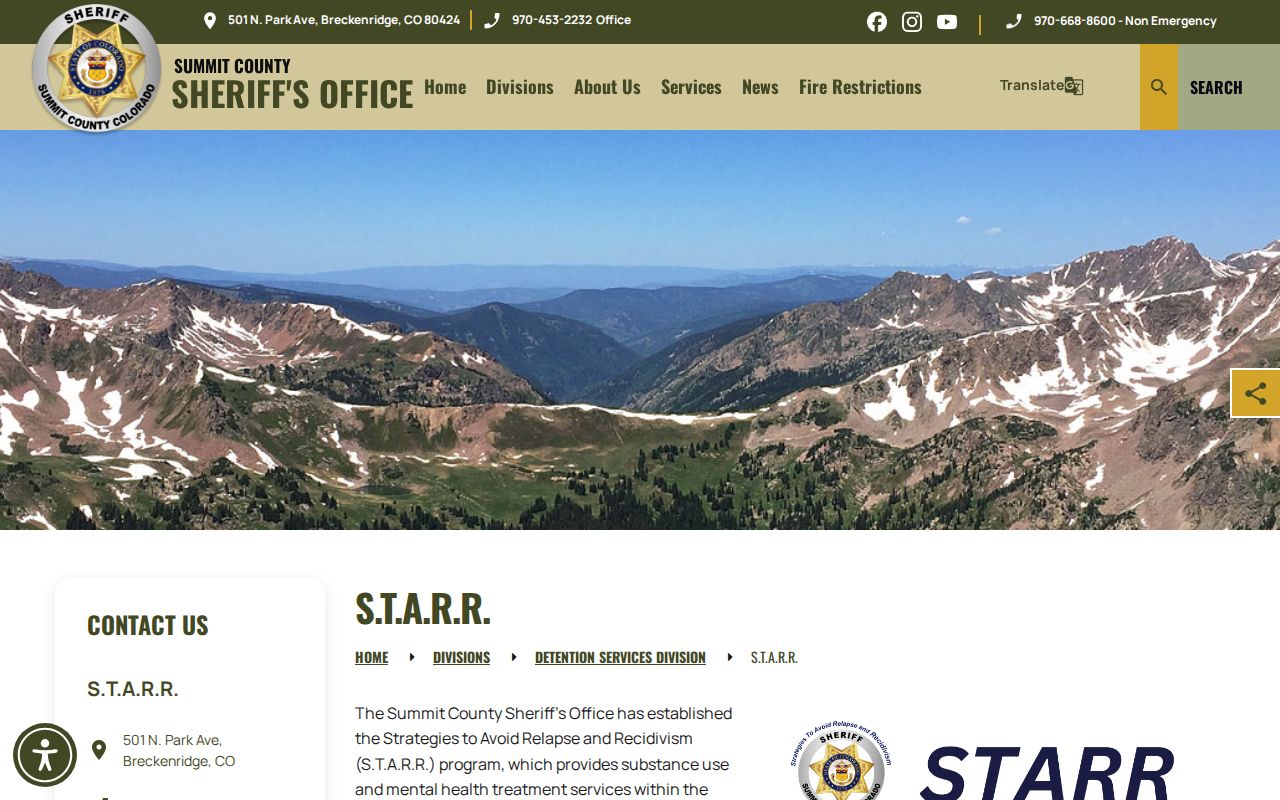
The screenshot supports the local post-release angle by showing that Summit's own detention materials discuss reentry linkage after jail release.
Property After Summit Release
Summit publishes a clear inmate-property process. The sheriff's Inmate Services page says inmate property can be released to family or friends after the inmate completes a release form specifying what property to release. It also says property can be obtained Monday-Friday during business hours. Inappropriate mail is placed in the inmate's property bag, which the inmate receives when released from the facility.
Property release does not verify parole or probation, but it can be part of the practical handoff after a person leaves custody. A family member may be able to pick up authorized property before release, while the person may receive other property during out-processing. For supervision questions, use probation, court, CDOC, or parole records. For property questions, use Summit County Detention Services.
Summit County Parole Hearings
For a Summit County defendant sentenced to state prison, the parole hearing calendar is a release-decision tool, not a county jail roster. The Colorado State Board of Parole calendar inside the CDOC offender search site displays monthly calendars and warns that parole hearings and scheduling are subject to change. It also says modifications made by DOC are available the following business day.
Parole outcomes require careful wording. Granted means parole has been approved subject to conditions and processing. Denied means no parole release from that hearing. Deferred or continued means no final release action yet. Rescinded means a prior grant was taken back before release. Revoked means parole was terminated after violation proceedings and custody may resume. Discharged means the sentence or parole obligation ended.