
Projected vs Actual Release Date
A projected release date is a current estimate. An actual release date is the date custody changed. Summit County jail releases can occur by bond, personal recognizance, court order, sentence completion, time served, probation sentence, transfer, dismissal, or another hold. A bond release has timing rules but is not a sentence calculation. A state-prison release date is different because CDOC applies Colorado sentence, parole, earned-time, and discharge rules.
Pretrial custody is the easiest place to make a wrong assumption. A person held before disposition does not have a fixed release date in the same way a sentenced inmate might. The next event may be a bond posting, personal-recognizance order, hearing, dismissal, plea, sentence, warrant action, or transfer. The court explains legal authority. The jail confirms physical custody. CDOC applies only if the person is sentenced or transferred to state prison.
Scheduled is not final: A Summit County projected release date can change because of credits, holds, court orders, parole action, discipline, new cases, transfer, or data correction.
How to Find a Summit County Inmate's Release Date Lookup
The correct lookup depends on the sentence source. For a local Summit County sentence, use the court mittimus, jail records, presentence confinement credit, trustee or local jail deductions, and any hold or policy-violation changes. For state prison, use CDOC. For federal custody, use BOP. For a bond release, use the court order, jail release status, and bonding information rather than a projected sentence date.
- Identify whether the person is pretrial, sentenced to Summit County jail, sentenced to CDOC, in federal custody, or transferred to another agency.
- For local jail custody, contact the Summit County Detention Facility or request the releasable booking and release record from sheriff records.
- For the legal reason behind release, check the Summit County court docket, mittimus, bond order, disposition, or probation sentence.
- For state prison, search the CDOC offender search by DOC number if possible, then name and gender as needed.
- For custody-change alerts, register through VINE inmate check while the person remains in a participating active record.
- For federal custody, use the BOP inmate locator and remember that federal dates do not resolve Summit County or Colorado holds.
The CDOC offender search start page is captured in the project manifest and is relevant to state-prison release date checks.
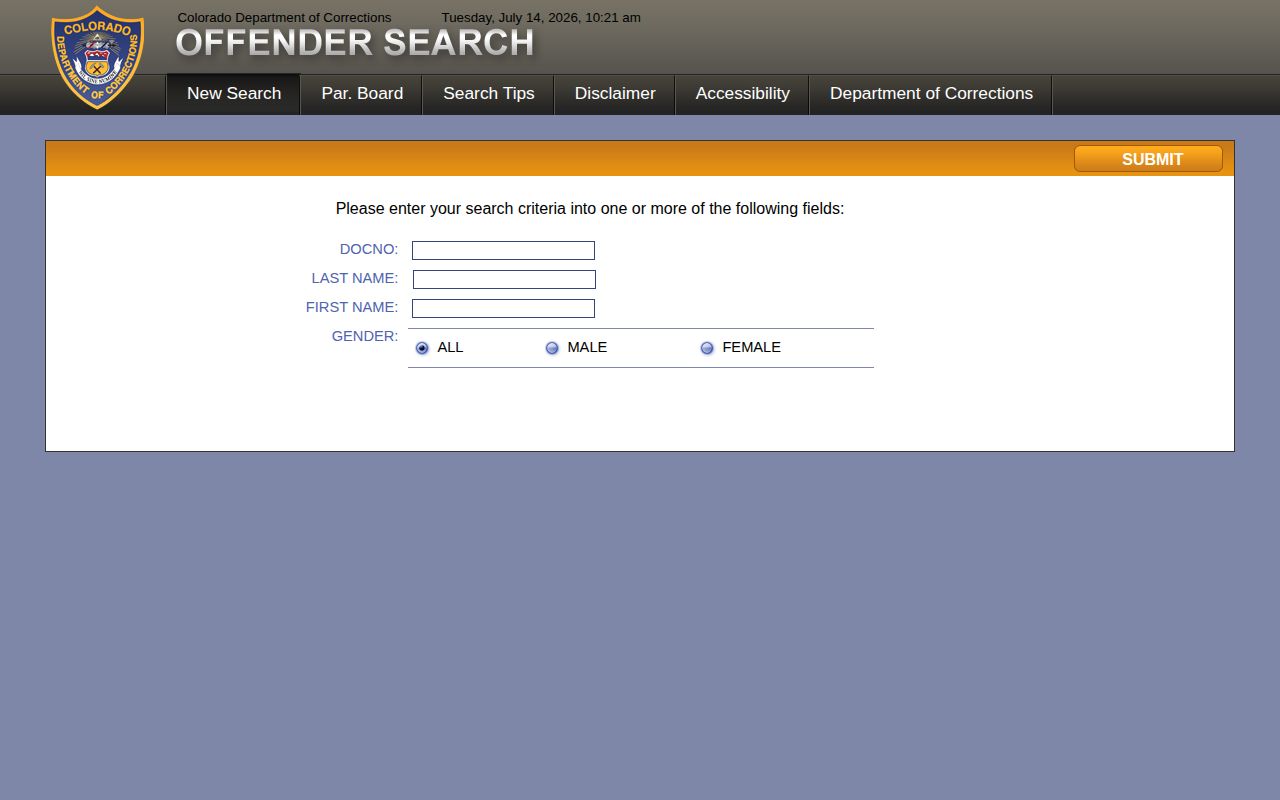
The image shows why DOC number is the cleanest search field when the person has been sentenced to Colorado state prison.
Summit County Good-Time Credit
Local jail release dates can involve court mittimus terms, presentence confinement credit, jail sentence calculations, trustee deductions, good-time or earned-time deductions, and changes after policy violations. Summit's Inmate Services page says trustees are statutorily eligible for additional good-time sentence reductions based on work performance. The Trustees page says eligible trustees earn days off their sentence. Colorado county-jail law also references jail records of deductions of time and changes in deductions of time after policy violations.
State prison dates use a different framework. CRS 17-22.5-405 governs Colorado earned time and allows earned time within statutory limits for consistent progress in listed areas, with different rules for certain offense classes. That can affect parole eligibility, mandatory release, and discharge calculations, but it is not a guaranteed early release formula.
Some Colorado offenses require a larger portion of the sentence before parole eligibility. Research flags 2024 Proposition 128 changes for certain violent felonies, but the page should not apply one universal percentage to every person. Offense date, offense type, sentence type, statute, credits, detainers, and CDOC calculation control the displayed date.
Why a Release Date Lookup Changes
Projected dates move because they are calculations inside a live custody system. CDOC release dates can change after earned-time updates, disciplinary changes, parole board action, rescission, revocation, new sentences, consecutive terms, or detainers. Local jail dates can change after trustee credit, policy violations, corrected jail credit, court orders, or a new hold. A projected date should be treated as a current public pointer, then confirmed with the agency that controls the custody.
| Change Factor | Effect on Release Date |
|---|---|
| Trustee or local jail credit | May shorten a Summit County jail sentence if earned and recorded. |
| Policy violation or discipline | May reduce or remove credit and move the date later. |
| Detainer or hold | Can prevent community release even when one sentence or booking ends. |
| Court order | Can release, remand, resentence, recall a warrant, or change custody authority. |
| Parole board action | Can grant, deny, defer, rescind, revoke, or re-parole a state-prison release. |
| Data correction | Can change CDOC, jail, or court records after review. |
Confirming a Release Date
Confirmation should match the custody system. For local Summit County jail custody, call the Detention Facility or request a releasable sheriff record. For the court reason behind the release, use the docket or clerk. For CDOC state-prison custody, use the public offender search and confirm official time computation or discharge details through CDOC records or case channels. For federal custody, BOP explains that release dates may change because sentences are reviewed and recalculated for federal time credits.
VINE helps with notification rather than certified records. Register for a custody-change alert when the person remains in an active participating record, then use the sheriff, court, CDOC, BOP, ICE, or receiving agency to verify the exact release date, time, and type. A release from Summit County custody can be a transfer to another system rather than release into the community.
Note: CDOC's public disclaimer says users should confirm information because database records may contain inaccuracies.
Summit County Work Release Timing
Summit has local work-release and trustee rules that can affect custody timing. Work Release requires 5th Judicial District court authorization plus final approval from the Detention Services Commander. The research lists a required deposit before program start, daily charges that differ by sentencing source, and weekly testing fees. Those program rules should not be confused with a public release-date calculator. They are custody-program facts that can affect how a local sentence is served.
Trustee status is more directly tied to release-date math. The sheriff's Trustees page says eligible trustees earn days off their sentence, and Inmate Services says inmate trustees are statutorily eligible for additional good-time sentence reductions based on work performance. That is why a Summit County local jail sentence completion date can move. Ask the jail or court for the actual calculation instead of trying to subtract days from the sentence by hand.
The Summit trustee page is captured in the manifest because it documents the local sentence-credit wrinkle.
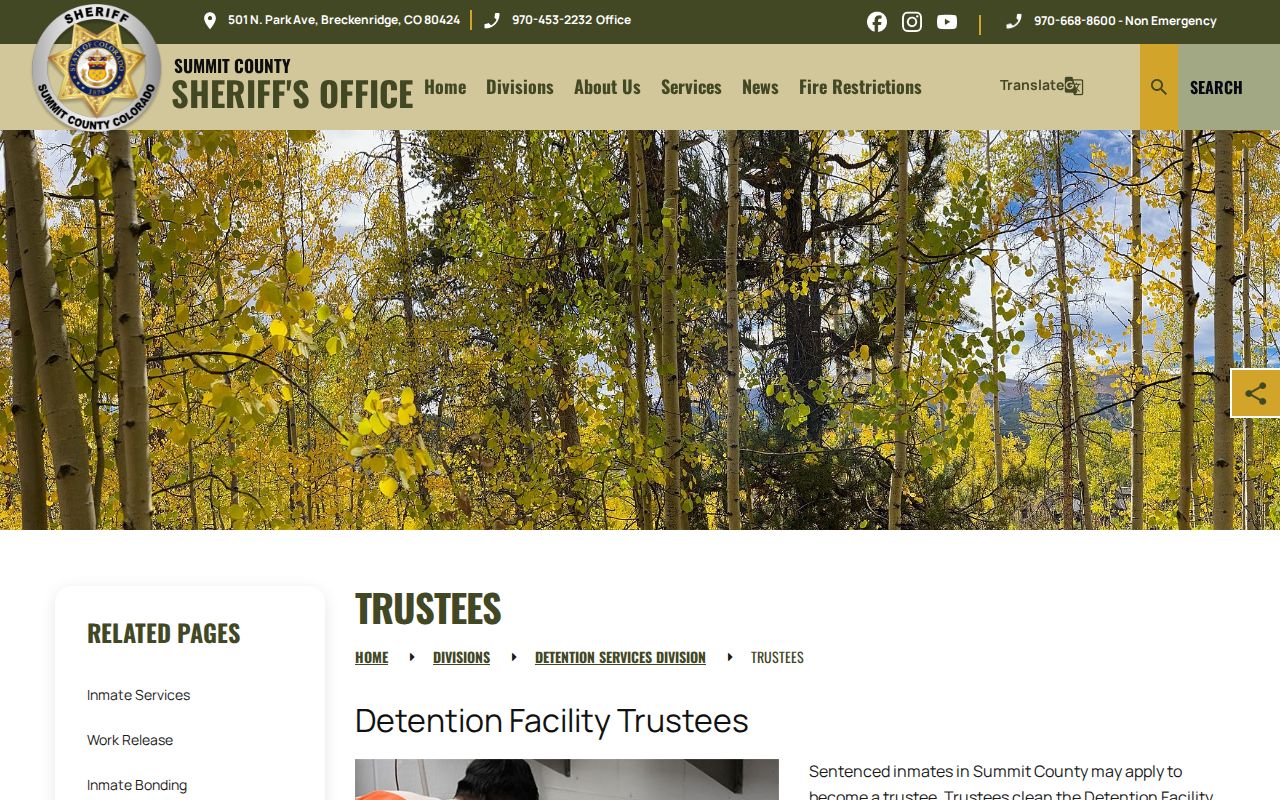
The source supports the local distinction between a simple sentence length and a calculated jail release date.
CDOC Summit County Release Dates
For a Summit County defendant sentenced to Colorado state prison, the public CDOC profile may include Parole Eligibility Date, Next Parole Hearing Date, and estimated mandatory release date language. The exact public profile labels should be read from the current CDOC screen because CAPTCHA and interface changes can affect access. A parole eligibility date is the earliest date the person can be considered by the State Board of Parole, not an automatic release date.
An estimated mandatory release date is CDOC's current calculation for release from incarceration to parole or discharge if no other hold, recalculation, or board event changes it. Actual release may occur later because a parole plan must be approved, a detainer may exist, a rescission may occur, or a new case may intervene. Discharge means the sentence or supervision authority has ended.
Summit County Bond Release Timing
Bond timing is separate from a projected sentence date. Summit's Inmate Bonding page says bond can be posted by cash, credit card, or bonding agent. The same page posts the Colorado rule that release should occur within the statutory six-hour window after qualifying personal-recognizance or cash-bond conditions are met unless extraordinary circumstances exist, with a possible 24-hour extension for required electronic-monitoring fitting.
When someone asks "when will they be released" after bond is set, the better question is whether the bond condition has been met, whether the person has returned to jail for processing if required, whether electronic monitoring is involved, and whether any other hold exists. A bond release does not end the case. It changes custody while the court case continues.
Summit County CDOC Date Caution
CDOC's public search disclaimer is part of the release-date workflow. The research notes that CDOC expects website information to be accurate, but the database may sometimes contain inaccurate information and users should contact CDOC to confirm all information. That does not make the public search useless. It means the public profile is a pointer to state-prison status, not a certified time-computation certificate.
The disclaimer is especially important when a Summit County case has multiple systems attached to it. A CDOC date may reflect the state sentence while a county court case, federal matter, ICE hold, restitution order, registry duty, or parole condition remains separate. The displayed date should be saved with the date searched, then confirmed through CDOC records, the case manager, parole channels, or the court when official proof is needed.
The CDOC disclaimer page is also captured in the manifest.
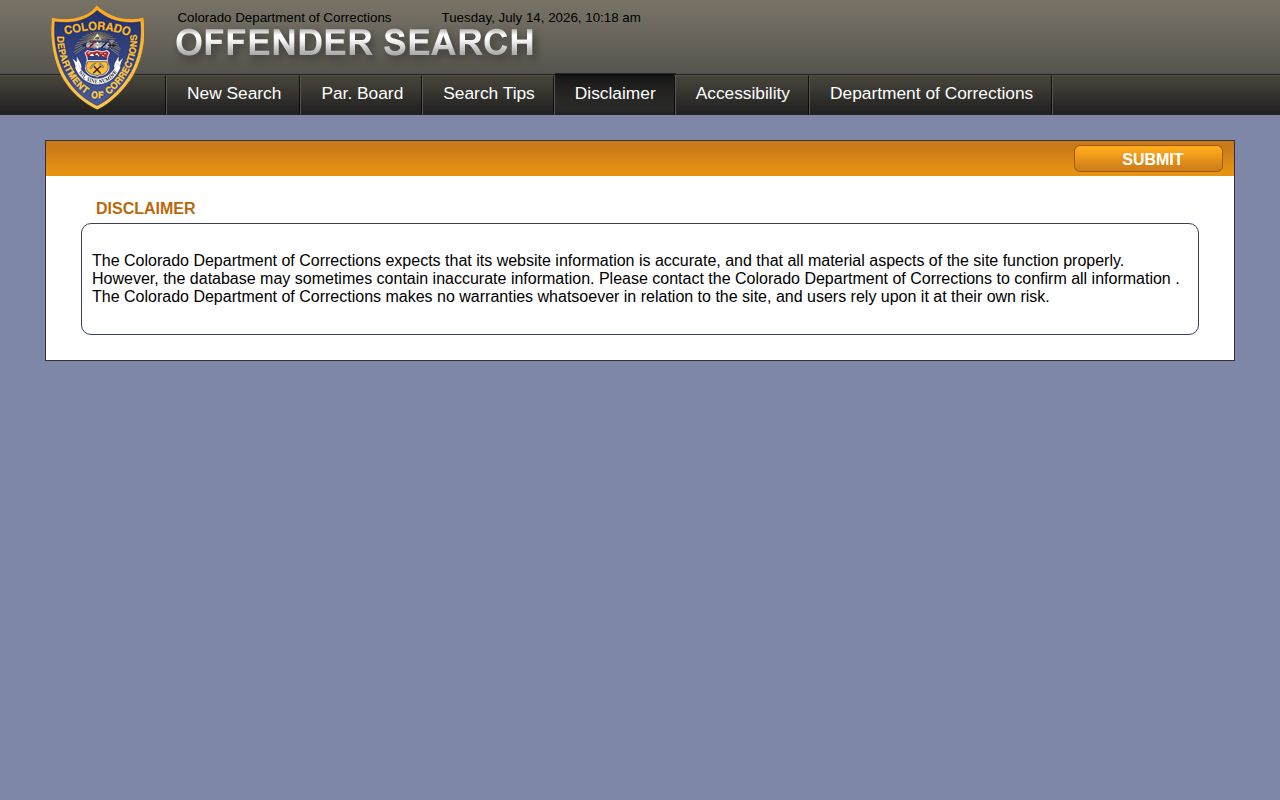
The source supports the instruction to verify public release-date data before treating it as final.
Parole Hearings and Release Dates
A parole hearing date is not the same thing as a release date. The Colorado State Board of Parole calendar can show application, rescission, revocation, or other hearing schedules. The research notes that hearings are subject to change, scheduling is subject to change, and DOC modifications are available the following business day. A grant can still require plan approval, processing, and clearance of holds before actual release.
For Summit County state-prison cases, read the hearing date with the CDOC profile. Parole eligibility means the person can be considered. A next parole hearing date means a decision event is scheduled or expected. Estimated mandatory release is a calculated date subject to credits and holds. Actual parole release is the custody event. Discharge is the end of sentence or supervision authority. Those terms should not be collapsed into one "release date."
For local jail cases, the parole calendar is usually irrelevant. A Summit County jail-only sentence turns on the mittimus, jail credit, trustee deductions, holds, and court orders. A person on probation is supervised through the court path, not the parole-board calendar.